
See also


 10.06.2026 12:49 AM
Next week, the Bank of England will hold its next meeting, and current market expectations lean towards the interest rate remaining unchanged. The main limiting factor for the central bank is not so much the moderate growth in inflation as the rapid deterioration of economic indicators.
The PMI index for May shows a noticeable slowdown in economic activity after a strong growth in April. Particularly indicative is the sharp decline in the services sector—the steepest in the last four years. Conversely, the manufacturing sector is currently stable, with consistent growth in production and orders. Retail sales in April reflected a decline in consumer sentiment, showing the most significant monthly drop in a year. In April, job losses accelerated (-100,000), and the unemployment rate reached 5.0%.
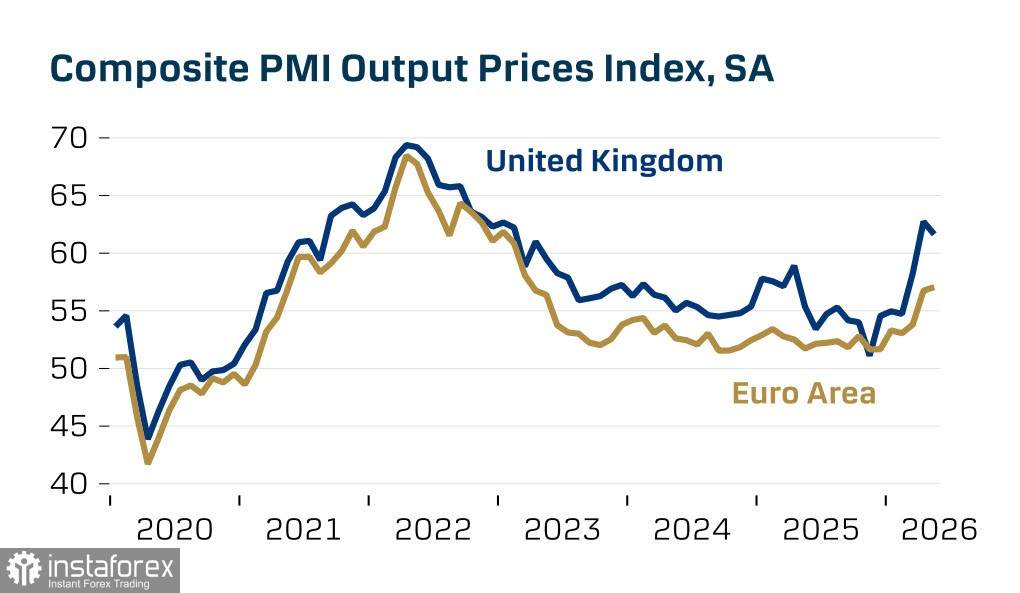
All of these are quite troubling data points, limiting the BoE's ability to adjust interest rates. Although inflation in April was lower than expected (core inflation continued to decline, and the impact of energy prices has not yet fully manifested), the situation could change. Producer prices are already showing strong growth in both sectors—manufacturing and services. This growth significantly outpaces the Eurozone indicators, creating a basis for it to be reflected in consumer prices in the near future.
Despite systematic calls for a rate hike, BoE Governor Andrew Bailey maintains a cautious rhetoric. He admits the possibility of exceeding the target inflation level, citing uncertainty about the impact of the war in Iran on the economy and weak growth rates.
Overall, the situation appears complex. The BoE must balance the need to combat inflation with the risk of exacerbating the impending economic downturn. Much will be clarified next week, as reports on industrial production, the trade balance, consumer inflation, and the labor market will be sequentially published before the BoE meeting.
Comparing the threats faced by the European Central Bank and the BoE, the latter's threats are clearly higher, suggesting that the dynamics of the pound are likely to underperform compared to the euro.
The net short position in the pound has decreased over the reporting week to -4.4 billion; the bearish advantage is stable, yet the calculated price indicates a rising likelihood of corrective growth.
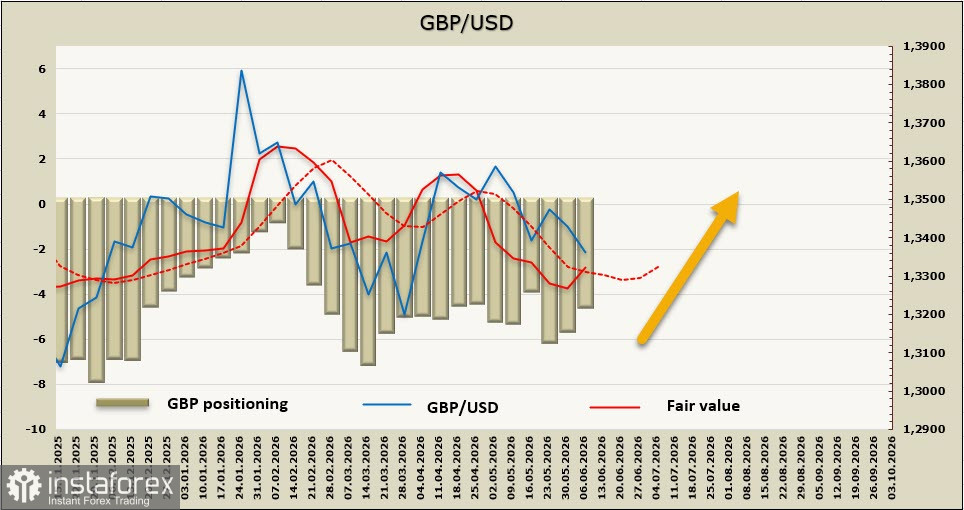
Previously, we expected the GBP/USD pair to decline to the support level of 1.3299. The pound fell slightly short of this mark, and now the probability of an upward bounce has increased; however, there are no reasons for confident growth. The nearest resistance is in the 1.3440/50 range, where sell-off renewals are possible.
If the U.S. inflation report on Wednesday is weaker than expected, growth may continue towards 1.3508. However, long-term reasons for a bullish reversal are not observed, so after the completion of the correction, another downward impulse is expected, updating support at the levels of 1.3299/3305.


