
यह भी देखें


 16.03.2026 06:48 AM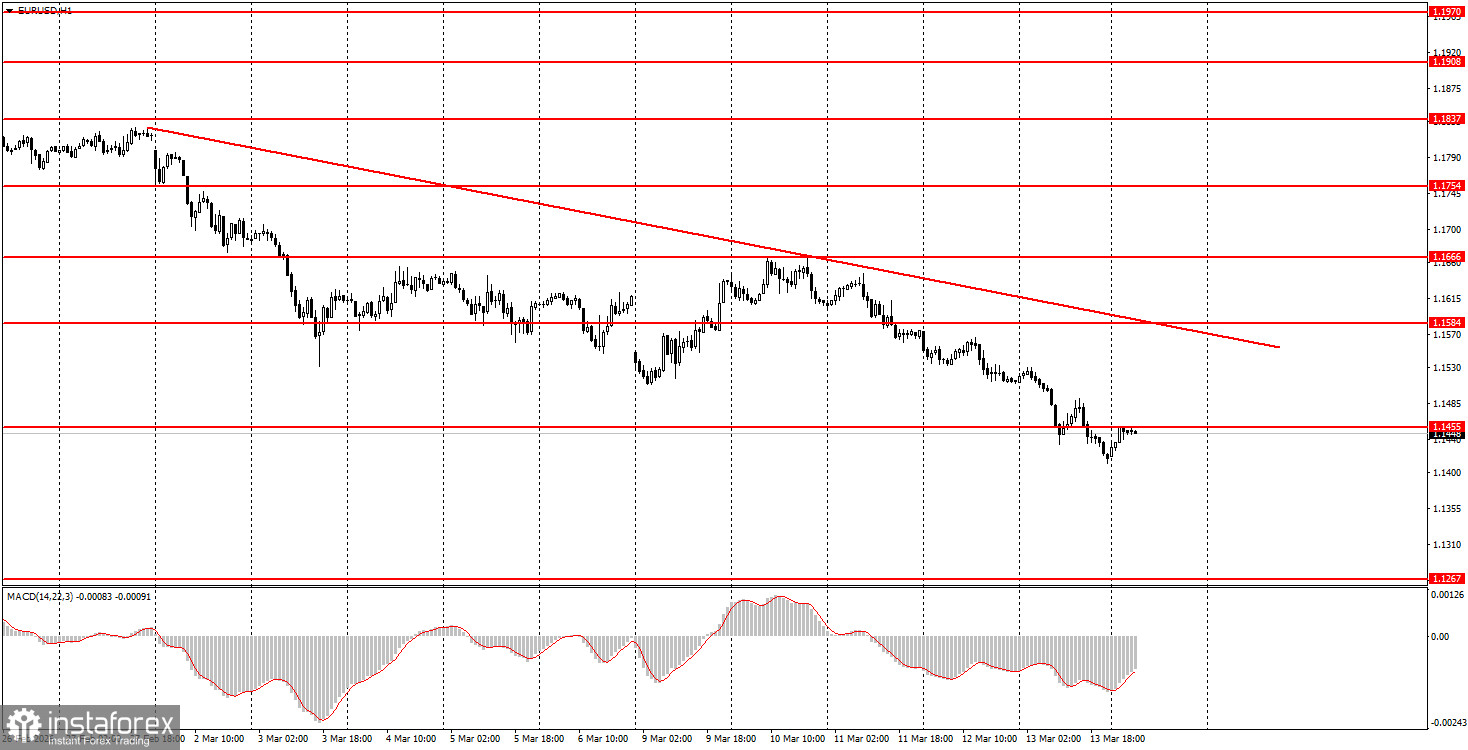
The EUR/USD currency pair continued its steady decline on Friday, again unrelated to anything other than geopolitics. The decline did not stop even overnight, indicating the market's confidence in its actions. A week ago, we observed a panicked collapse and a flight to safety, but now there are well-considered, justified dollar purchases, not based on emotion. As before, the macroeconomic backdrop has no impact on traders' sentiment or the pair's movements. On Friday, at least two absolutely disastrous reports on US GDP and durable goods orders were released, yet this did not dampen the US dollar's mood. As in all previous cases, the negative reports for the American currency were simply ignored by the market. As a result, we have seen a continued decline in the EUR/USD pair, driven by the war in the Middle East. By the way, it became known overnight that Yemen may close the Bab-al-Mandab Strait, which will clearly not improve the situation with oil and gas worldwide.
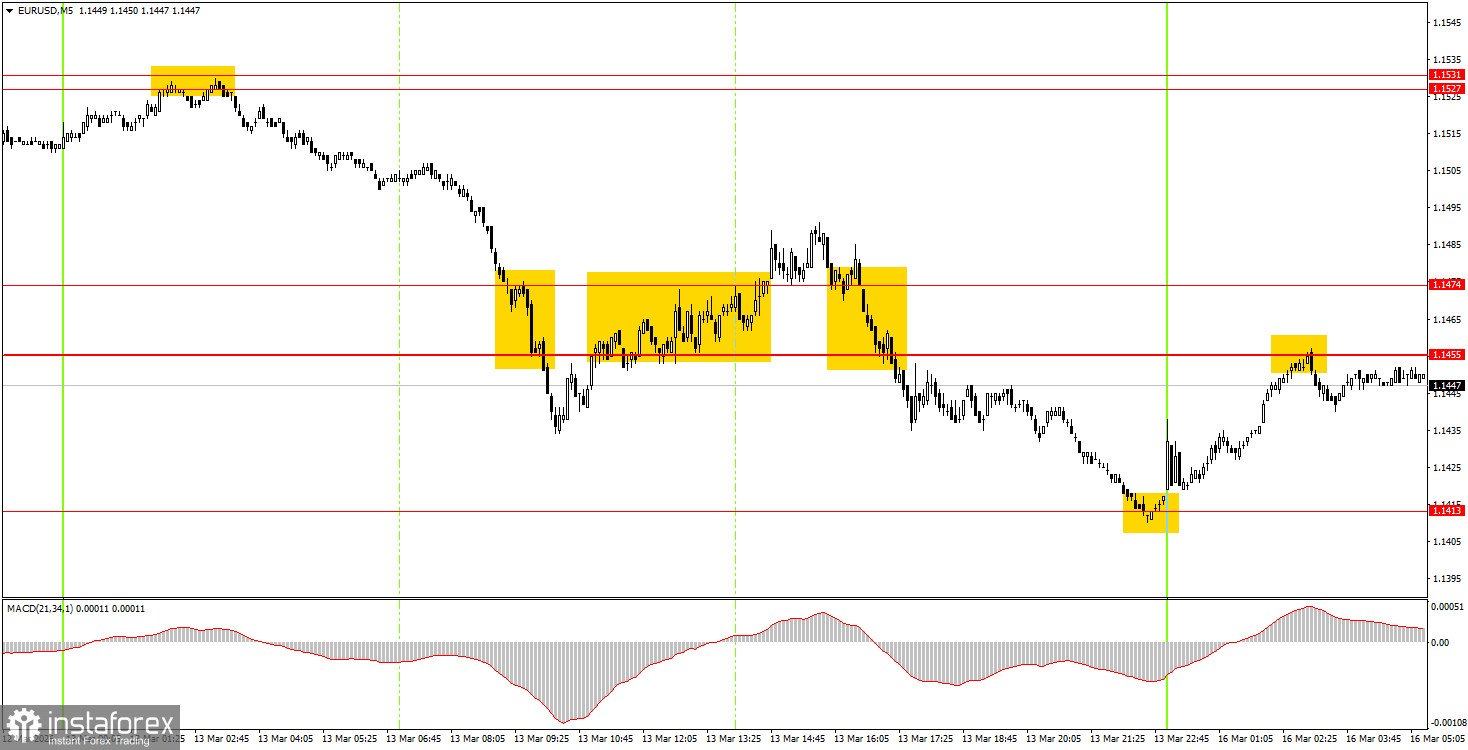
On the 5-minute timeframe, the first trading signal was formed overnight on Friday. The pair bounced from the area of 1.1527-1.1531 (clearly visible in the illustration), then fell to the area of 1.1455-1.1474, and even lower. However, during the American trading session, the dollar faced some pressure for a time, which led to the formation of a buy signal. This was a false signal. Shortly after, the decline of the euro resumed, producing another sell signal, which, like the first, allowed novice traders to profit—the nearest target, 1.1413, was achieved.
On the hourly timeframe, the downward trend continues due to the war in the Middle East. At the beginning of 2026, the long-term upward trend recovered, so we anticipate a new medium-term rise in the euro. The fundamental backdrop remains very challenging for the American currency, as evidenced by reports on the labor market, GDP, and unemployment. However, for the market right now, geopolitics, not economics, is the main focus.
On Monday, novice traders may consider new short positions if there is a bounce from the 1.1455-1.1474 area, targeting 1.1413 and 1.1354-1.1363. If the price consolidates above the 1.1455-1.1474 area, long positions can be opened with targets at 1.1527-1.1531.
On the 5-minute timeframe, it is advisable to consider the levels: 1.1267-1.1292, 1.1354-1.1363, 1.1413, 1.1455-1.1474, 1.1527-1.1531, 1.1584-1.1591, 1.1655-1.1666, 1.1745-1.1754, 1.1830-1.1837, 1.1899-1.1908. On Monday, the only publication of the day will be Germany's industrial production data. It is unlikely that the market will even take note of this report.
Price levels of support and resistance are levels that serve as targets when opening buys or sells. Take Profit levels can be placed around them.
Red lines represent channels or trend lines that show the current trend and indicate the direction in which it is preferable to trade now.
The MACD indicator (14,22,3) – the histogram and the signal line – is a supporting indicator that can also be used as a source of signals.
Important speeches and reports (always included in the news calendar) can significantly affect the movement of the currency pair. Therefore, during their release, trading should be done with utmost caution, or traders should exit the market to avoid sharp price reversals against the previous movement.
Beginning traders in the forex market should remember that not every trade can be profitable. Developing a clear strategy and effective money management are the keys to long-term trading success.

