
यह भी देखें


 25.05.2026 03:54 AM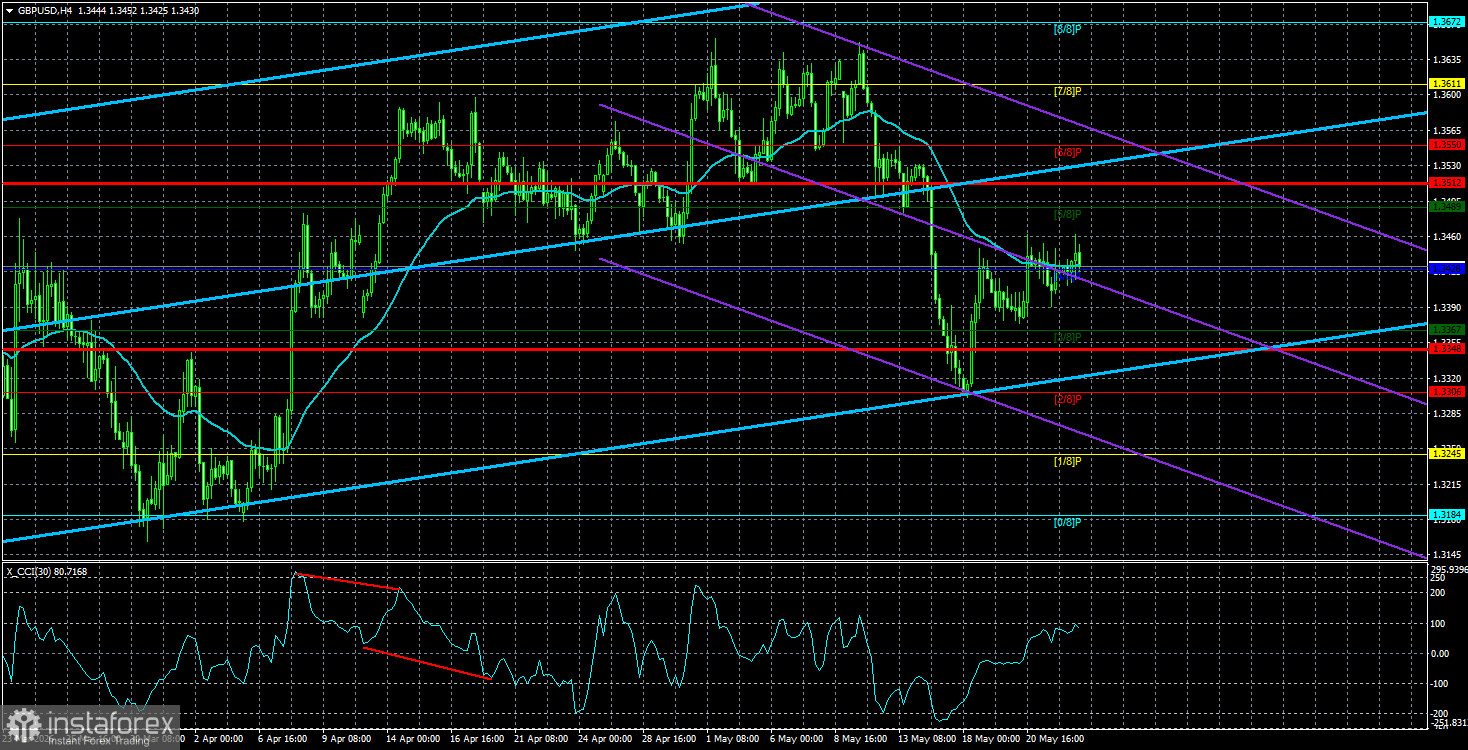
The GBP/USD currency pair unexpectedly rose by 100 pips over the past week, even though most macroeconomic data were disappointing for the British pound. Noteworthy were the reports on unemployment and inflation, which fueled the primary pessimism regarding the pound's prospects. However, strangely enough, the British currency not only held its ground but even gained ground. This can be explained simply. The week prior, the pound lost about 300 pips, and we believe the market had already factored in the inflation report, nullifying the necessity for the Bank of England to tighten policy next month.
At this point, we can say the following. All the most important data in the UK have already been published. In the U.S. this week, there will be only a few, more or less significant reports, which will not drastically affect the technical picture or trader sentiment. The most interesting event of the week will be the speech by Bank of England Governor Andrew Bailey on Friday. Bailey rarely speaks publicly, so each such event carries more weight than the speeches of Powell or Lagarde. Moreover, the market knows what to expect from the Federal Reserve and the European Central Bank in June, but it is unclear what to expect from the BoE.
On the one hand, inflation in the UK has slowed to 2.8%, making it impractical to tighten monetary policy. On the other hand, the slowdown in inflation could be coincidental. Bailey could guide the market regarding the central bank's decision at the next meeting. However, even Bailey's speech will take a back seat. Geopolitics will remain in the foreground. In particular, on Monday, the British pound may continue to rise amid increased optimism about an agreement between Iran and the U.S.
Over the weekend, Trump announced via social media that a deal with Tehran is nearly reached, with only a few details left to discuss. Therefore, this week, the document (the memorandum of understanding) may be signed, after which the parties will move on to discussing a full and long-term peace deal while concurrently reopening the Strait of Hormuz. But can we be certain everything will go as smoothly as Trump indicates? There is no clear evidence of this from Iran yet. We would not be surprised if top officials in Tehran announced today that no agreement exists and that the Strait of Hormuz will remain blocked. Such instances have occurred numerous times over the past weeks.
Thus, we do not expect a significant decline in the U.S. dollar this week, unless an agreement is actually signed, even if it is temporary or merely a framework agreement. The same applies to the growth of the U.S. dollar; it can only be expected if there is misinformation from Trump again or if hostilities resume in the Middle East.
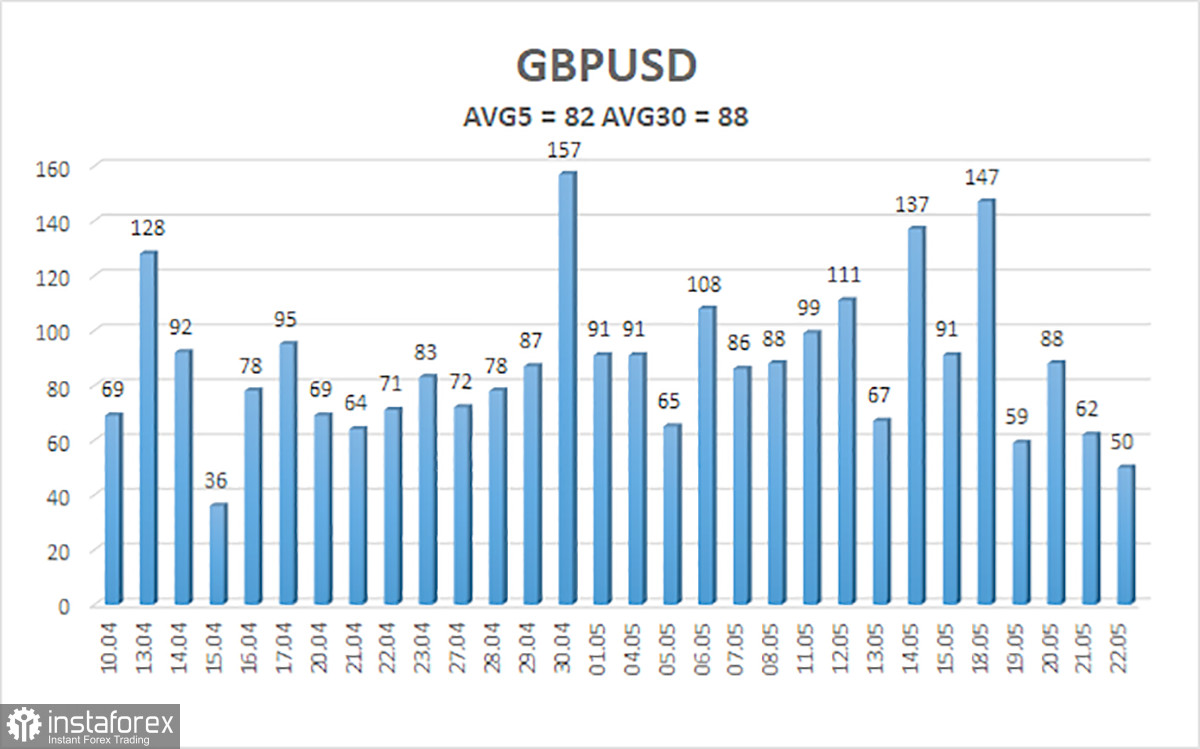
The average volatility of the GBP/USD pair over the last 5 trading days is 82 pips. For the pound/dollar pair, this value is considered "average." On Monday, May 25, we expect the movement to occur within the range limited by levels 1.3348 and 1.3512. The upper channel of the linear regression is directed upwards, indicating a recovery of the upward trend. The CCI indicator has not formed any signals recently.
S1 – 1.3428
S2 – 1.3367
S3 – 1.3306
R1 – 1.3489
R2 – 1.3550
R3 – 1.3611
The GBP/USD currency pair has sharply declined, so the upward trend is not currently relevant. Trump's policies will continue to exert pressure on the U.S. economy, so we do not anticipate long-term growth from the American currency. However, 2026 may still prove to be super-positive for the dollar. Thus, long positions with targets at 1.3489 and 1.3512 can be considered when the price is above the moving average. When the price is below the moving average line, short positions can be traded with targets at 1.3367 and 1.3348 based on geopolitical grounds. The situation in the market often changes; the market continues to primarily track geopolitical news, which does not exhibit uniform characteristics.
Linear regression channels help determine the current trend. If both are directed in the same way, the trend is currently strong;
The moving average line (settings 20,0, smoothed) determines the short-term trend and the direction in which trading should be conducted right now;
Murray levels are target levels for movements and corrections;
Volatility levels (red lines) indicate the probable price channel in which the pair will reside over the next 24 hours, based on current volatility metrics;
CCI indicator – its entry into the oversold area (below -250) or overbought area (above +250).

