
यह भी देखें


 02.07.2026 02:35 PM
Visa, Stripe, Mastercard, BlackRock, Coinbase, and more than 140 other companies have announced the launch of a new stablecoin, Open USD (OUSD). The project is built on three principles that notably distinguish it from existing stablecoins such as USDT and USDC.

First, scalability: businesses will be able to mint and redeem OUSD for free and without artificial volume limits. Second, yield by default: partners receive all income from the stablecoin's reserves, minus a small fee to cover the operating expenses of Open Standard, the project's operator. Third, shared governance: decisions will not be made by a single issuer but by a board of directors formed from the project's partners. Open Standard founder and CEO Zak Abrams summed up the idea this way: businesses need a stablecoin that is open, cheap, high-performing, widely accessible and works in the interests of the companies themselves, not a single issuer.
The partner list is impressive in scale and covers nearly every segment of the financial industry. Payment giants, in addition to Visa, Stripe, and Mastercard, include American Express, Klarna, PayPal rival Affirm, and Western Union. The banking cohort includes BNY, Standard Chartered, Japan's Sumitomo Mitsui, DBS Bank and BBVA. From the crypto industry, the project counts Ripple, OKX, Gemini, MetaMask, Aave, and the Solana blockchain, as well as Tempo, an institutional L1 blockchain for stablecoin payments from Stripe and Paradigm, built on the Reth SDK and compatible with EVM. Technology companies Google, Samsung Electronics, and Shopify have also joined the project. Comments from participants are telling: Samara Cohen, head of global market development at BlackRock, called Open USD a constructive step toward expanding business options for access to tokenized value, and BNY forecasts the entire stablecoin market to grow to $1.5 trillion by 2030.
The full launch of Open USD is scheduled for the end of this year, although the official release does not yet specify which blockchain will be used to issue the token. The project's emergence fits into the large institutional wave we have seen over recent weeks: Mastercard and Visa are separately developing their own stablecoin infrastructures; three of Japan's largest banks are launching a joint token. Fidelity, State Street, and Invesco are creating money market funds for issuers' reserves to meet GENIUS Act requirements.
What sets Open USD apart is that, instead of competition between individual issuers, more than 140 of the world's largest companies have chosen to unite around a single neutral standard with distributed governance and yield directed to partners rather than to a third-party issuer.
Trading recommendations

Bitcoin
Buyers are currently targeting a return to $60,600, which opens a direct path to $62,600, and from there, $64,000 is within reach. Breaching that level would signal attempts to return to a bull market. In case of a Bitcoin decline, buyers are expected around $58,500. A return of the instrument below that area could quickly push BTC toward $56,100. The furthest target is the $53,600 area.
Ethereum
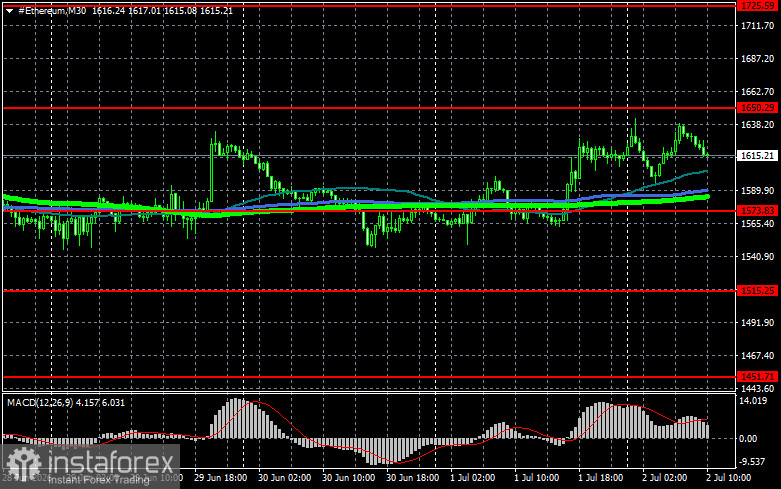
A clear hold above $1,650 opens a direct path to $1,725. The furthest target is the high around $1,774; surpassing that would indicate strengthening bullish sentiment and renewed buyer interest. If Ethereum declines, buyers are expected around $1,573. A return below that area could quickly push ETH toward $1,515. The furthest target is the $1,451 area.
What's on the chart
Price testing or crossing any of these moving averages often either halts movement or injects fresh momentum into the market.

