
Vea también


 06.07.2026 01:24 PM
Trade analysis and trading tips for the Japanese yen
The price test at 162.27 occurred at a moment when the MACD indicator had already moved significantly above the zero line, which limited the pair's upward potential. A second test of 162.27 triggered Scenario #2 for selling the dollar; however, no actual decline in the pair followed.
In the second half of the day, the market awaits a set of important US data — the ISM services index and the composite PMI — as well as a speech from FOMC member Christopher Waller. Business activity indices are based on surveys of companies and reflect trends in new orders, employment, and price pressures; a reading above 50 indicates expansion, while below 50 signals contraction. For the market, the most important factor is the deviation from consensus forecasts, as it reshapes expectations for the Fed's interest rate path and drives dollar movements. The Japanese yen reacts primarily through US Treasury yield dynamics. Strong data and hawkish rhetoric from Waller push USD/JPY higher: rising US rates widen the yield differential with Japan, making the yen less attractive. Conversely, weak data and a cautious tone from the regulator narrow this spread, restore demand for the yen as a safe-haven asset, and push the pair downward.
Regarding the intraday strategy, greater emphasis is placed on scenarios #1 and #2.
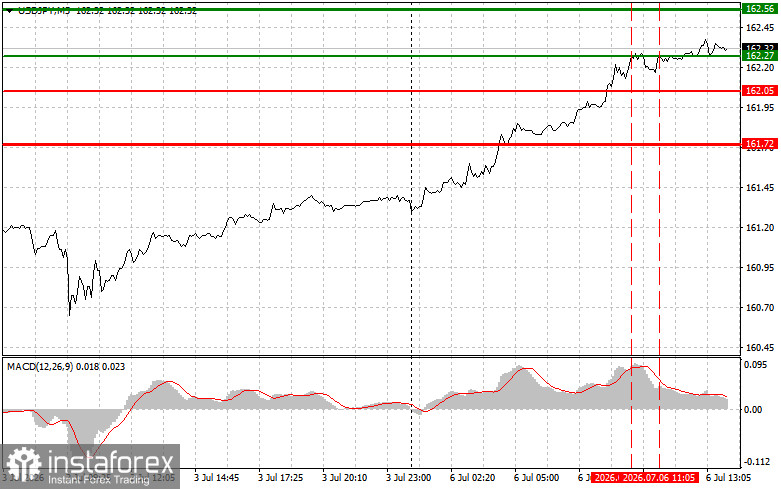
Buy signal
Scenario #1: Buying USD/JPY today is planned at the entry point around 162.44 (green line on the chart) with a target of 162.82 (thicker green line on the chart). At 162.82, positions will be closed and reversed into sells, expecting a 30–35 point move in the opposite direction from the level. Upward potential today is possible but relatively limited. Important: before buying, ensure that the MACD indicator is above the zero line and has just started rising from it.
Scenario #2: Buying USD/JPY is also planned if there are two consecutive tests of 162.44 at a time when the MACD indicator is in oversold territory. This would limit downward potential and lead to a reversal upward. A move toward 162.22 and 161.85 can be expected.
Sell signal
Scenario #1: Selling USD/JPY today is planned after a break below 162.22 (red line on the chart), which would lead to a quick decline in the pair. The key target for sellers is 161.85, where positions will be closed and immediately reversed into buys (expecting a 20–25 point move in the opposite direction from the level). Downward pressure on the pair may return in the case of central bank intervention. Important: before selling, ensure that the MACD indicator is below the zero line and has just started moving downward.
Scenario #2: Selling USD/JPY is also planned if there are two consecutive tests of 162.44 at a time when the MACD indicator is in overbought territory. This would limit upward potential and lead to a reversal downward. A decline toward 162.22 and 161.85 can be expected.
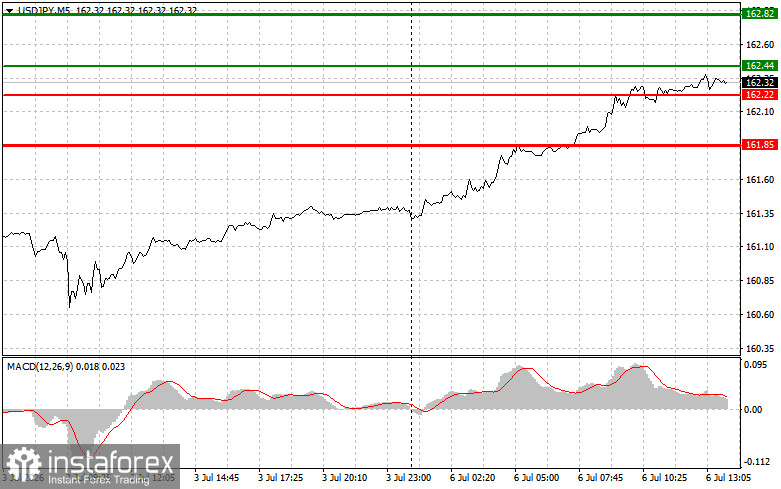
What is shown on the chart:
Important: beginner Forex traders should be very cautious when making market entry decisions. Before major fundamental reports are released, it is best to stay out of the market to avoid sharp volatility. If trading during news releases, always use stop-loss orders to minimize losses. Without stop-loss orders, it is possible to lose the entire deposit very quickly, especially without proper money management and when trading large volumes.
And remember: successful trading requires a clear trading plan, similar to the one presented above. Spontaneous trading decisions based on current market conditions are, from the outset, a losing strategy for intraday traders.


