
Vea también


 06.07.2026 07:03 PM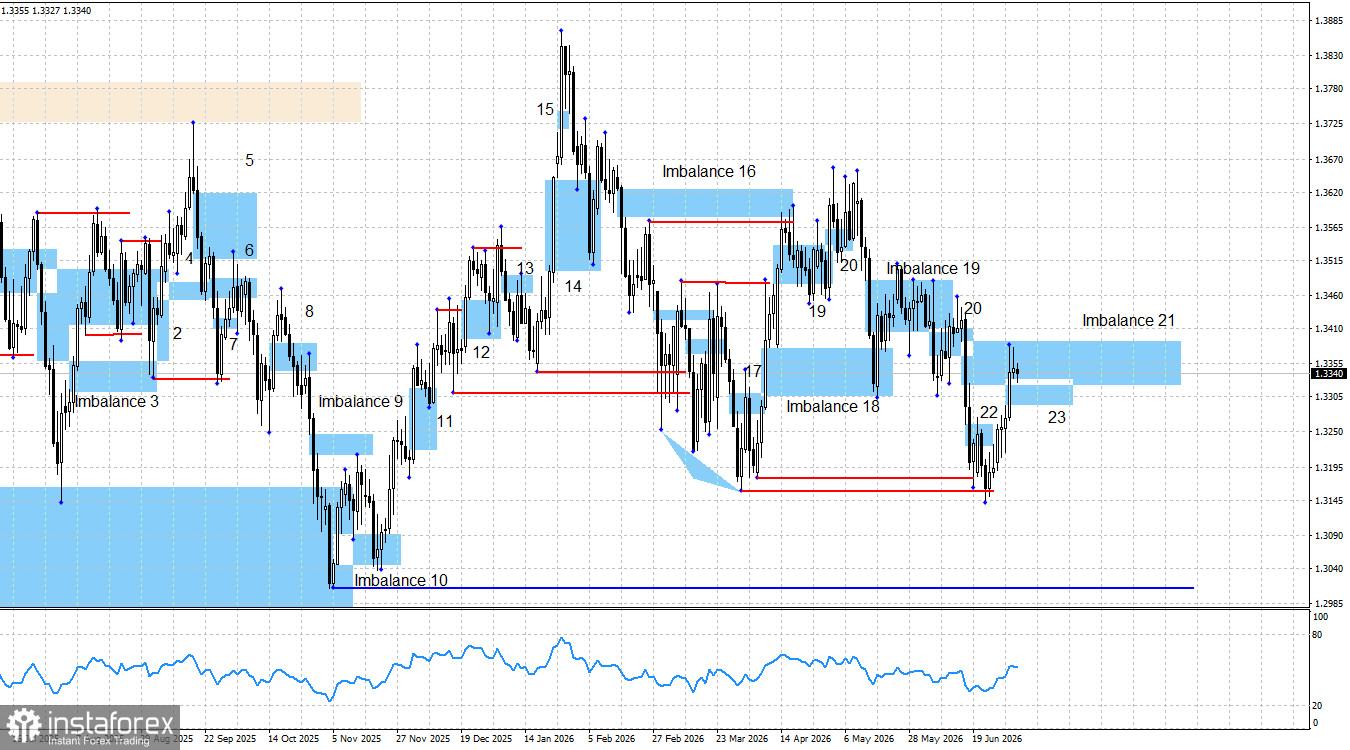
The GBP/USD pair has reversed in favor of the pound and posted a fairly strong advance that could mark the beginning of a broader bullish trend. In my view, the US dollar's rally between June 17 and June 24 was inconsistent with the underlying fundamental backdrop. The geopolitical conflict in the Middle East has ended, yet it was the primary driver of the dollar's strength in 2026. As a result, seeing the dollar rise first because of the war and then continue rising after the conflict ended is, at the very least, unusual. The FOMC meeting and the Fed's hawkish tone certainly justified buying the dollar, but its rally continued for nearly two weeks. The FOMC has not yet begun tightening monetary policy, and if inflation starts to slow, it may not do so at all. Kevin Warsh's remarks did not provide a clear answer as to whether the Federal Reserve intends to raise interest rates in July or September. He stated that inflation needs to decline but gave no indication of any imminent change in monetary policy. US labor market data was weak enough to encourage the bulls to become more aggressive, while the market began to question the likelihood of near-term monetary tightening by the FOMC. As a result, Bearish Imbalance 21 has been fully worked off, and the key question now is whether this bullish advance will continue. An invalidation of Imbalance 21 would signal a break in the local bearish market structure.
The technical picture pointed to a move toward 1.3322, which is exactly what occurred. Liquidity was first swept below the April 6 low and then below the March 31 low. Therefore, there were solid technical grounds for expecting further strength in the pound. Given that the US dollar still lacks compelling reasons for a sustained long-term uptrend and has already posted an impressive rally in 2026, it appears unlikely that the bears will be able to maintain further pressure. In addition, Bullish Imbalance 23 was formed last week, and price may react to it in the near future. The pound is currently trapped between two opposing imbalances, leaving the market waiting for a resolution. One of these imbalances is likely to be invalidated, while the other should generate a meaningful market reaction. At this stage, the bulls continue to hold the stronger position.
For now, the market remains cautious regarding the agreement between Iran and the United States. However, it can at least be said that the active phase of the conflict has officially ended. The FOMC triggered a strong rally in the US dollar, but it remains unclear what could continue to support further bearish pressure on GBP/USD. Can expectations of future monetary tightening alone be enough?
The UK economic calendar was empty on Monday, while the US ISM Services PMI is due for release shortly. This report is likely to trigger a market reaction that could influence the current technical picture. As a result, tomorrow should provide a clearer indication of which imbalance is ultimately invalidated.
The broader fundamental backdrop still suggests that, over the long term, the US dollar is more likely to weaken than strengthen. Even the conflict between Iran and the United States has not altered that outlook. Nor has the possibility of Fed rate hikes in 2026. Geopolitical tensions temporarily reminded the market of the dollar's safe-haven status, but the conflict has ended or is at least entering its final stage. The Federal Reserve intends to raise interest rates in 2026, which is undoubtedly supportive for the dollar. However, tighter monetary policy would also slow the US economy and weaken the labor market. Moreover, Kevin Warsh was appointed by Donald Trump as FOMC Chair to pursue a more accommodative monetary policy—something Jerome Powell was unwilling to deliver. Therefore, any tightening cycle is unlikely to become prolonged or evolve into a sustained policy trend. For that reason, any appreciation of the US dollar is likely to be temporary rather than structural.
United States
The economic calendar for July 7 contains only one event. Therefore, the impact of economic data on market sentiment on Tuesday is expected to be minimal or nonexistent.
The long-term outlook for the pound remains bullish. Following liquidity sweeps below the last two major swing lows, the bulls have an opportunity to regain control. The pound could still resume its decline toward the bullish trend invalidation level at 1.3007, but this would require fresh bearish signals. A sell signal can only emerge within Imbalance 21. Supporting the bullish case are the two liquidity sweeps, as well as Bullish Imbalance 23. This bullish pattern gives buyers greater confidence to continue pushing higher. If price reacts to Imbalance 23, the next upward targets will be the highs of May 1 and January 27 at 1.3656 and 1.3867, respectively. If the market instead reacts to Imbalance 21, the downward target will be the 1.3139 low.


