
यह भी देखें


 07.05.2026 12:50 AM
The USD/JPY pair sharply declined on Wednesday— in just an hour, the price fell almost 300 points. This is the second anomalous price movement in the last two weeks. Last Thursday, April 30, the pair dropped nearly 500 points within a few hours, from 160.73 to 155.58. Then, over the following three trading days, the yen actively lost positions. Buyers of USD/JPY regained some losses and returned to the 158 area amid a general strengthening of the greenback. And now, with a new turn of events, Japanese authorities have brought the pair back into the 155-figure range.
The April price collapse and Wednesday's decline share the same nature and are linked to currency interventions. On Wednesday, we saw what could be described as a "second series" — and perhaps not the last.
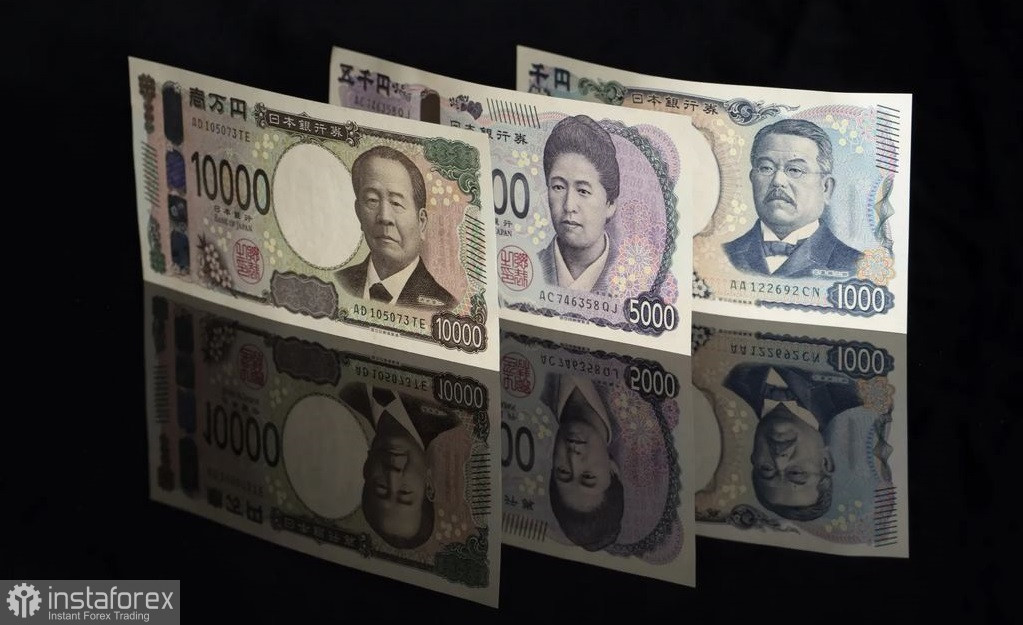
It is noteworthy that the market did not receive official confirmation of the intervention (Japan only confirms it after the fact), so on Wednesday, we can discuss only indirect signs, based on which traders "read" the central banks' involvement. In particular, this relates to the speed and scale of the price movement. The pair plummeted nearly 300 points against a nearly empty economic calendar. Geopolitical factors (which we will discuss below) contributed to the decline in USD/JPY, but not in a sharp, large-scale manner. When the price plummets "out of nowhere," it is a clear sign of a major player's "work" (in this case, the Japanese Ministry of Finance).
It should also be noted that Japan is currently in the "Golden Week" — a series of public holidays. On April 30, when the first round of currency intervention took place, the country celebrated Showa Day. On Wednesday, Japan also observes an official holiday (in honor of Children's Day, celebrated on Tuesday), so Japanese banks and funds are closed (or operating on a reduced schedule), major participants are absent, and liquidity is low. This is an optimal moment for conducting a currency intervention, as a significant "shift" in the exchange rate requires fewer currency reserves than on a regular trading day.
Official representatives of the Japanese government (Finance Minister Satsuki Katayama and her deputy) neither confirmed nor denied the intervention, using veiled language about their ministry "carefully monitoring speculative movements" and being "ready to respond to the situation 24/7." This is the standard position of the Ministry of Finance when an intervention has already been conducted or is under consideration.
However, as the saying goes, "not by intervention alone." The USD/JPY pair has been pressured by other interrelated fundamental factors.
The trigger for the greenback's weakening was a report from Axios stating that the US and Iran are close to signing a 14-point memorandum of understanding intended to resolve the Middle East conflict. If insiders from the publication are to be believed, the parties agreed on the gradual opening of the Strait of Hormuz and the lifting of mutual maritime blockades. Then, during a "30-day period of silence," representatives from Washington and Tehran must develop a detailed peace treaty. According to preliminary, unconfirmed data, Iran allegedly agreed to a moratorium on uranium enrichment for a period of 12 to 15 years.
The oil market reacted instantly to these (as yet unconfirmed) rumors — specifically, WTI crude fell by almost 10%, dropping to around $91-93 per barrel, while Brent fell below the psychologically significant level of $100.
As is known, Japan is a structural net importer of energy resources, so the decline in oil prices reduces import costs and eases pressure on the trade balance through the energy component. This reduces the currency outflow associated with purchasing fuel and other energy carriers, thus weakening the fundamental pressure on the yen. Furthermore, lower energy prices reduce industry and transportation costs, supporting the profitability of the export sector.
Thus, the downward dynamics of USD/JPY are driven not only by currency interventions (i.e., the market's confidence in such interventions) but also by geopolitical fundamentals.
After the pair updated a 2.5-month price low at 155.05, a substantial (130-point) price correction followed amid new threats from Donald Trump against Iran (he threatened to resume bombings if Tehran refused to comply with the agreements reached). However, in my view, given the current circumstances, these corrective pullbacks should be used as an opportunity to open short positions.
Firstly, another round of currency intervention is not ruled out (for example, in 2022, Japanese authorities implemented a multi-step, three-wave operation), which will exert additional pressure on USD/JPY. Secondly, if the aforementioned Axios insider is to be believed, the US and Iran may be nearing the conclusion of a framework deal in the coming days. If this insider is confirmed, the safe-haven dollar will face additional pressure, as will the USD/JPY pair.
From a technical standpoint, the pair is at the lower end of the Bollinger Bands indicator on the daily timeframe and below all lines of the Ichimoku indicator, suggesting a bias toward short positions. The nearest target for a downward movement is the level of 155.05, corresponding to the lower line of the Bollinger Bands on the four-hour chart.

