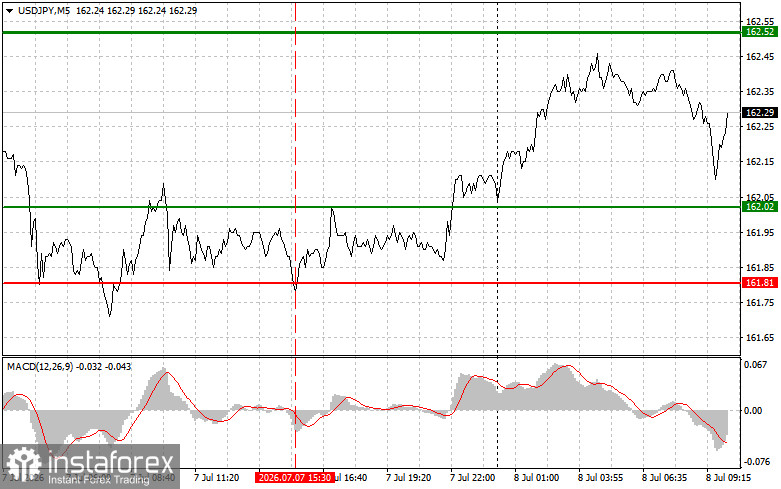
The price test at 161.81 occurred when the MACD indicator had moved significantly below the zero mark, limiting the pair's downward potential. For this reason, I did not sell the dollar.
The USD/JPY pair was not unaffected by the military escalation around the Strait of Hormuz, which pushed the dollar higher and renewed pressure on the yen. U.S. retaliatory strikes against Iran, following their attack on three commercial vessels, heightened concerns about the stability of oil supplies and prompted a shift of funds into safe assets. In this context, the Japanese yen finds itself in a conflicting position. On one hand, it is traditionally considered a safe haven and usually strengthens during periods of turmoil; on the other hand, the rise of the dollar and the potential increase in oil prices work against it, as Japan is almost entirely dependent on energy imports. However, it is important to remember that if the dollar's strengthening drives USD/JPY up too quickly, the risk of currency intervention by the Bank of Japan will increase, as it has repeatedly intervened in the market to prevent excessive weakening of the national currency during such stressful episodes.
Regarding the intraday strategy, I will primarily rely on the implementation of scenarios No. 1 and No. 2.
Buy Scenarios
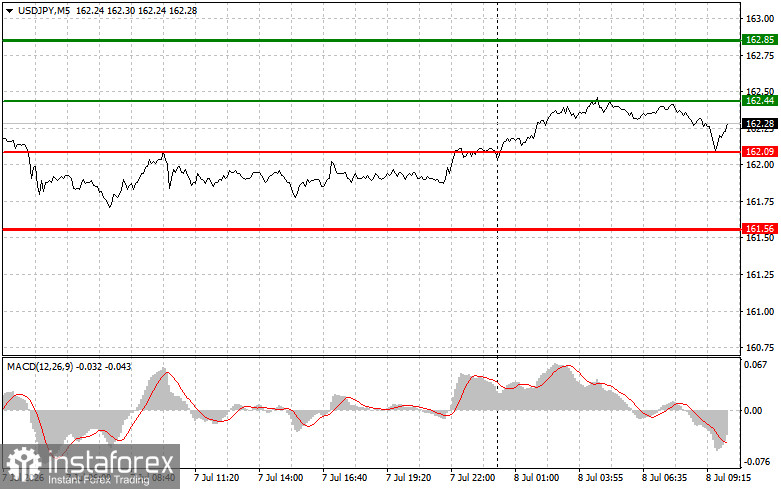
Scenario No. 1: I plan to buy USD/JPY today at an entry point around 162.44 (green line on the chart), targeting a rise to 162.85 (thicker green line on the chart). At around 162.85, I will exit from long positions and immediately sell in the opposite direction (aiming for a movement of 30-35 pips back from that level). It's best to return to buying the pair during corrections and significant dips in USD/JPY. Important! Before buying, ensure that the MACD indicator is above the zero mark and just beginning its rise from it.
Scenario No. 2: I also plan to buy USD/JPY today if there are two consecutive tests of the price 162.09 while the MACD indicator is in the oversold area. This will limit the pair's downside potential and lead to an upward market reversal. You can expect growth towards opposing levels of 162.44 and 162.85.
Sell Scenarios
Scenario No. 1: I plan to sell USD/JPY today only after it breaks the level of 162.09 (red line on the chart), which will trigger a rapid decline in the pair. The key target for sellers will be 161.56, where I intend to exit short positions and immediately buy in the opposite direction (aiming for a move of 20-25 pips back from that level). Sellers may return at any moment; just a hint from the central bank could trigger action. Important! Before selling, ensure that the MACD indicator is below the zero mark and just beginning its decline from it.
Scenario No. 2: I also plan to sell USD/JPY today if there are two consecutive tests of the price 162.44 while the MACD indicator is in the overbought area. This will limit the pair's upward potential and lead to a downward market reversal. You can expect a decrease towards opposing levels of 162.09 and 161.56.
What the Chart Shows:
The thin green line represents the entry price for buying the trading instrument;
The thick green line is the estimated price at which to set Take Profit or lock in profits, as further upward movement is unlikely above this level;
The thin red line is the entry price for selling the trading instrument;
The thick red line is the estimated price at which to set Take Profit or lock in profits, as further downward movement is unlikely below this level;
The MACD indicator. It is important to base market entries on overbought and oversold zones.
Important: Beginning traders in the Forex market must make entry decisions very cautiously. Before the release of significant fundamental reports, it is best to stay out of the market to avoid sudden price fluctuations. If you decide to trade during news releases, always set stop orders to minimize losses. Without stop orders, you can quickly lose your entire deposit, especially if you do not use money management and trade with large volumes.
And remember, for successful trading, it is necessary to have a clear trading plan, similar to the one I have presented above. Making spontaneous trading decisions based on the current market situation is fundamentally a losing strategy for intraday traders.
You have already liked this post today
*A análise de mercado aqui postada destina-se a aumentar o seu conhecimento, mas não dar instruções para fazer uma negociação.



 08.07.2026 09:20 AM