
See also


 23.06.2026 12:17 AM
On Sunday, the first round of negotiations between Iran and the U.S. took place in Switzerland. If we strip away all the "fluff," the outcomes were as follows: Iran gained the right to export oil, which should return about 1.5 million barrels per day to the global market. Iran achieved the unfreezing of some of its assets. The parties also agreed on a "roadmap" for further negotiations and a plan for Iran's reconstruction. If we are talking about tangible results, one could rate the first round of negotiations a 5+. At the very least, the Iranian delegation can give itself such a rating.
However, experts point out that the situation in the Middle East remains "volatile." Washington has fulfilled its commitments under the memorandum of understanding, and the parties now have at least 60 days to address the most pressing issues, particularly the nuclear question. Here, as always, everything is shrouded in ambiguity. It is known that on Sunday, the issue of Iran's nuclear energy was not addressed, which also aligns with the background of the negotiations. Let me remind you that Iran demanded the lifting of the naval blockade, the lifting of sanctions on oil exports, and the unfreezing of assets before moving on to the nuclear issue. Well, its conditions have been met. Now we await the progress of the "nuclear negotiations".
If Tehran and Washington resolve all contentious issues but fail to reach an understanding on the nuclear question, military conflict in the Middle East could resume. I do not think this is likely before the U.S. congressional elections, as Donald Trump needs to quickly announce a deal with Iran to lower fuel prices domestically and emerge as a winner to boost his political ratings. However, all market participants understand that without a nuclear deal, a resumption of war is just a matter of time. In my view, a new conflict in the Middle East is likely, but closer to 2027, when Trump will have a clearer understanding of the balance of power in Congress.
Let me remind you that if the Democrats win the House of Representatives (which is practically guaranteed), Trump will not be able to make all decisions in the country alone. He will need the approval of the Democrats, for example, for new attacks on Iran or for imposing trade tariffs. Certainly, the White House leader would prefer to avoid such an outcome. Therefore, he is currently willing to make any concessions in hopes of persuading Iran to abandon its nuclear weapon ambitions. However, the U.S. president has already "laid down some straw," stating that Iran has a general right to nuclear weapons, just like any other country.
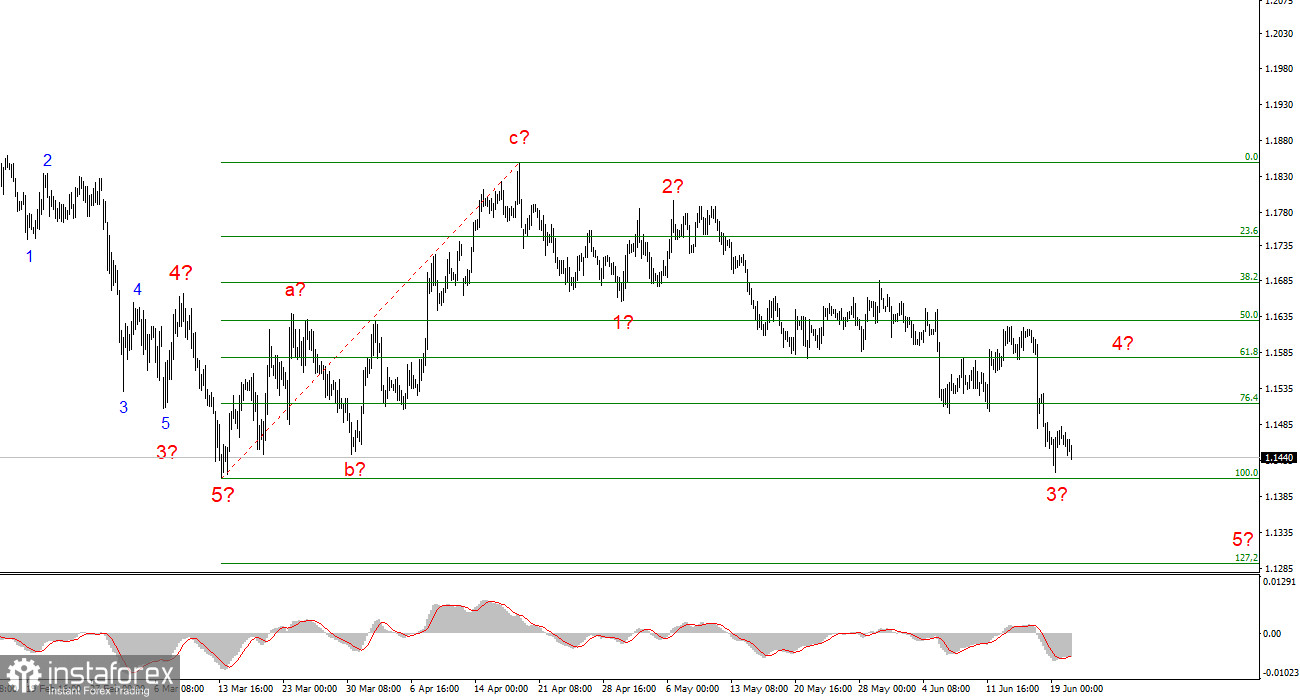
Based on the analysis of EUR/USD, I conclude that the instrument remains within an upward segment of the trend, while in the shorter term, it is in a downward segment that may be nearing completion. In my opinion, it is a good time to attempt to form long positions, but the instrument may drop below the 14 level within wave C. If this assumption holds true, it would be better to wait a bit longer. I believe the market will also take into account the European Central Bank's tightening and the possibility that the geopolitical conflict between Iran and the U.S. may be resolved soon.
The wave picture for the GBP/USD instrument has become clearer. Currently, the instrument has formed three waves down, while EUR/USD has formed five. Consequently, the pound may limit itself to forming a corrective structure, and both currency pairs may begin forming upward segments of the trend. At this moment, this is merely an assumption, but it is a plausible one. If it is correct, the instrument will start to rise, with targets around the 35 level and above, and market participants currently have a good opportunity to purchase.


