
Veja também


 08.07.2026 09:52 AM
The situation in the Strait of Hormuz has sharply escalated, leading to a spike in oil prices. According to Axios, citing two U.S. officials, Iran has attacked three commercial vessels within 24 hours. Overnight on Monday, Iranian military forces launched at least two missiles at commercial vessels, and by Tuesday morning, the Islamic Revolutionary Guard Corps had attacked a third vessel. This significant increase in intensity contrasts with previous isolated incidents, each of which the market regarded as a localized episode.

The U.S. response was extremely tough. Official representatives stated that Iran's actions in the strait are completely unacceptable and will have consequences. This was quickly confirmed by action, as the U.S. Central Command began carrying out a series of powerful strikes against Iran, calling them a direct response to the attack on three vessels. The official statement emphasized that the aggression shown by Iran was unprovoked, dangerous, and constitutes a clear violation of the ceasefire. This marks the first time in a long while that there has been a direct acknowledgment that the ceasefire established at the end of June has effectively been breached.
In parallel, Washington also targeted the financial aspect. The U.S. Treasury revoked the license issued on June 21 that permitted the production, delivery, and sale of Iranian oil, petrochemicals, and petroleum products until August 21. Only the winding down of already approved operations is now allowed, and even that is limited until July 17. Any new transactions, including purchases or loading of Iranian oil after July 7, are subject to a direct ban. This is a fundamental shift. It is worth recalling that this license and the associated 60-day window without tariffs underpinned the logic of restoring supplies from the region, which banking forecasts relied on for further declines in oil prices. Therefore, it is no surprise that WTI has risen to $72.75, after trading below $69 per barrel just yesterday.
The list of affected parties is expanding, and the geography of the attacks is widening. The Saudi Arabian Foreign Ministry stated that Iran attacked a Saudi tanker transiting through the strait, placing full responsibility on Tehran for such attacks and their consequences.
Iran, for its part, is attempting to frame the situation differently, shifting the responsibility onto the vessels themselves. The Iranian Foreign Ministry stated that commercial ships using routes not agreed upon with Tehran or interfering with tracking systems face risks and undermine Iran's efforts to ensure safe passage. This statement directly relates to Tehran's long-standing position on the right to control shipping through the strait jointly with Oman, a point reiterated by Deputy Foreign Minister Garibabadi. Essentially, Iran is trying to legitimize the attacks as measures to enforce its rules in the strait rather than acts of war.
For the markets, these events change the entire picture that had been built on the grounds of ongoing de-escalation just yesterday. The entire structure of falling oil prices, based on the recovery of supplies from the Gulf, the increase in OPEC+ quotas, and Saudi Aramco's aggressive discounting, is now facing a serious test. The key question is whether Iran will limit itself to attacks on vessels and receive a targeted response, as has happened before, or whether the conflict will escalate into a broader confrontation. The revocation of the U.S. oil license indicates that Washington is serious and prepared to use not only military but also economic pressure.
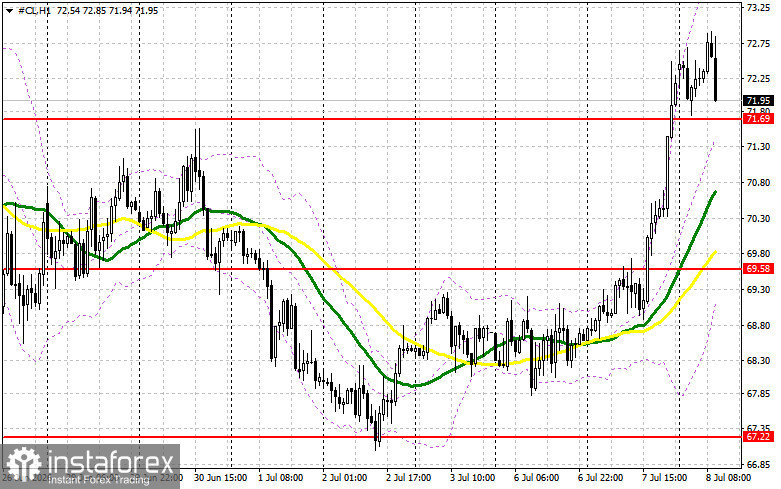
Regarding the current technical picture of oil, buyers need to reclaim the nearest resistance at $73.79. This would allow them to target $76.30, above which it will be quite challenging to break through. The farthest target will be around $78.70. In the event of a price decline, bears will attempt to regain control over $71.70. If successful, a breakout below this range would deal a serious blow to bull positions and push oil down to a low of $69.58, with the potential to reach $67.22.


