
Veja também


 08.07.2026 09:52 AM
Gold is down for the second consecutive day, returning to the significant support level of $4,100 per ounce. The reason, as always, is paradoxical and tied to oil.
Today, the U.S. Central Command announced it had launched powerful strikes in response to Iran's attacks on vessels in the Strait of Hormuz, just hours after Washington revoked the license allowing Tehran to sell oil globally. Against this backdrop, oil prices have risen, reigniting inflationary concerns.
The logic for gold here is complex and requires explanation. Any rebound in energy prices strengthens expectations that the Federal Reserve may keep rates high longer to combat persistent inflation. The high cost of borrowing is traditionally a headwind for gold, which does not yield interest, and a strengthening dollar makes dollar-denominated metal more expensive for buyers. Thus, the escalation of conflict works against gold through the interest rate channel, even despite rising geopolitical risks, which in other circumstances would have spurred demand for safe-haven assets.
The main event of the day will be the release of the minutes from the June FOMC meeting. Traders will be looking for clues regarding the future trajectory of rates. Recall that gold sharply dropped after that June meeting when the new Fed chairman Kevin Warsh took a more hawkish stance than the market expected. However, last week's weaker-than-anticipated employment data reduced the likelihood of an imminent rate cut and pushed gold above the psychological threshold of $4,000.
The scale of gold's recent decline underscores how serious the market shock has been. Since the war with Iran began at the end of February, the metal has depreciated by more than one-fifth, and the wave of profit-taking has completed a three-year bullish cycle, officially pushing gold into a bear market last month. At the same time, there is currently no solid evidence that investors are massively opening short positions in anticipation of further declines.
The long-term structural support for gold remains intact, providing an important counterpoint to short-term weakness. The People's Bank of China continued its gold purchases in June, extending the longest buying streak since at least 2015, underscoring the country's commitment to diversifying reserves despite price volatility. A June survey by the World Gold Council found that the number of central banks planning to increase their gold reserves over the next year reached a record high.
The market presents a picture caught between short-term hawkish uncertainty surrounding the Fed and geopolitical issues on one side and long-term structural support from central banks on the other. The FOMC minutes due out later today and further developments in the Strait of Hormuz will serve as key indicators for where the balance may shift in the coming days.
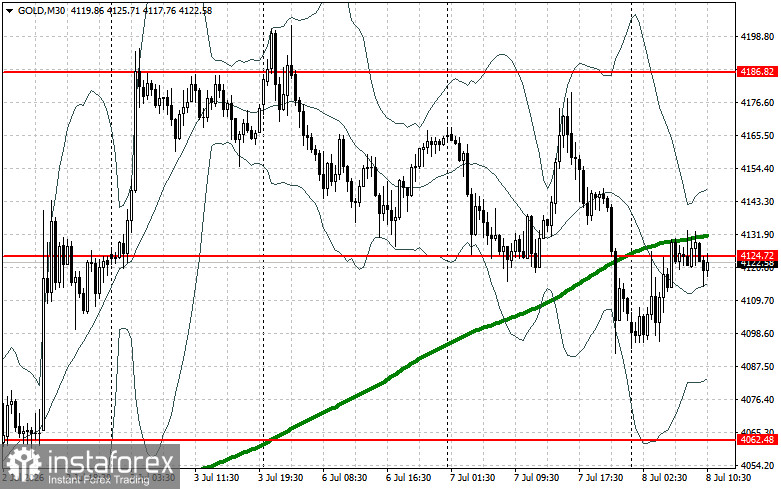
Regarding the current technical picture of gold, buyers need to reclaim the nearest resistance at $4,124. This would allow them to target $4,186, above which it will be quite challenging to break through. The furthest target will be around $4,249. In the event of a price drop, bears will attempt to regain control over $4,062. If successful, a breakout of this range will deal a serious blow to bull positions and push gold down to a low of $4,008, with the potential to reach $3,954.


